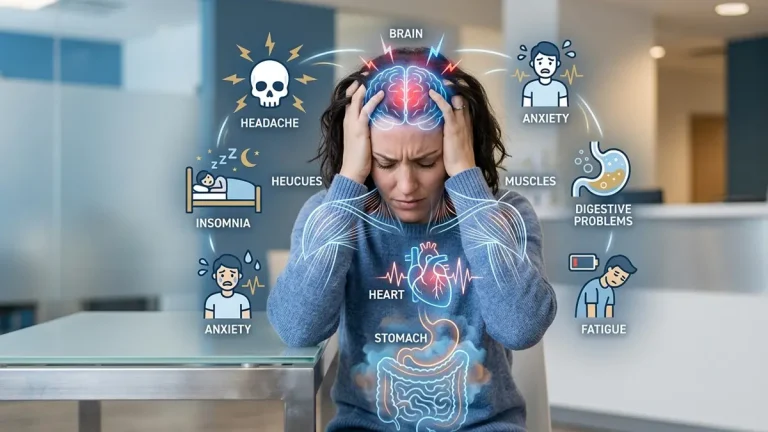



It is common for people suffering from anxiety to face sleep issues. Your body is in a fight-or-flight state, always overhyped or excited, or always on alert. Cortisol, the body’s major stress hormone, naturally drops in the evening—but when you are anxious, stress hormones push you into a state of hyperarousal. This causes a disturbance in the circadian rhythm, disrupting melatonin release.
Anxiety stops the body’s switch from sympathetic to parasympathetic mode in the evening, which is essential to fall asleep. The parasympathetic mode is the body’s rest-and-digest mode.
This is why insomnia is particularly common in anxiety disorders like post-traumatic stress disorder and generalized anxiety disorder. False alarms disrupt sleep-wake cycles, creating fatigue, low energy, and brain fog the following day at work. In fact, this accumulated sleep debt can further worsen your body’s natural resting state by disrupting cortisol levels even more. Sleep debt can cause persistent sleep difficulties.
This disregulates emotional processing circuits and disrupts sleep architecture.
How are anxiety disorders linked to insomnia?
Anxiety and insomnia go hand in hand. Around forty percent of Americans suffer from both insomnia and an anxiety or clinical mental health disorder. This makes insomnia both a symptom and a disorder.
Read More: Anxiety vs. panic attack
Insomnia coexists with other conditions like depression and substance abuse. Such people are dealing with hyperarousal and stress responses, and this is quite common. Anxiety fuels insomnia, and insomnia fuels anxiety, creating an endless loop of sleep debt and heightened stressful thoughts.
To break this cycle, try to understand your sleep and anxiety disorder from a psychological viewpoint. Instead of worrying or forcing sleep, it is important to detect the loophole and your source of discomfort.
As inferred, anxiety and insomnia share a strong two-way relationship. Research has shown that people suffering from generalized anxiety disorder, panic disorder, social anxiety disorder, and post-traumatic stress disorder are more likely to suffer from insomnia as well, as an underlying concern or symptom.
This is a signal of high comorbidity, as 70% to 80% of patients with anxiety disorders also have concurrent insomnia symptoms. It mostly includes mood disorders like major depressive disorder, dysthymic disorder, bipolar disorder, and substance abuse disorders. Sleep and anxiety disorders thus coexist.
Many people also suffer from chronic insomnia, and this interrupts one’s quality of life and impairs one’s professional performance.
Read More: How much sleep do you actually need?
During this state of physiological and mental hyperarousal, your brain’s threat detection system stays active. This neurological state prevents the body from drifting into sleep, blocking the brain’s biological processes of slowing down and moving into a state of deep rest and sleep.
Anxiety targets the hypothalamus-pituitary-adrenal axis, which is connected to the stress response of your body, releasing cortisol. This phenomenon counteracts the body’s natural lowering phase of cortisol before falling asleep. Anxiety is also known to lower the levels of gamma-aminobutyric acid, which is known to calm neural activity. All of these states are very important for the sleep mechanism of the brain.
Sleep and anxiety disorders can result in the occurrence of the following mental or physiological states:
- Racing thoughts causing inability to sleep
- Frequent nighttime awakening
- Restless, non-restorative sleep when your mind still feels awake and aware
- Frequent nighttime sleep disruptions
- Nightmares
How to improve Sleep and anxiety disorder
To improve this state of disrupted emotional regulation, your brain needs to switch to a natural safety mode. Sleep problems are instigated when it is forced. Therefore, follow simple, relaxing, yet evidence-based psychological techniques to guide your body into the long-awaited sleep.
Exercise your body as well as your mind.
People try hard to think themselves out of anxiety. However, sometimes too much thinking causes additional worries rather than relieving them. Excessive thinking is a symptom of anxiety and aggravates sleep and anxiety disorders.
Physical activity is one of the best natural methods to combat anxiety-induced insomnia since exercise reduces the level of stress hormones, improves the functioning of neurotransmitters responsible for mood, and increases sleep pressure.
Some activities you might engage in could be:
Mental workouts are just as important as physical ones. Just like the body, the brain also needs proper exercise throughout the day.
Examples of the latter could be:
- Reading
- Learning something new
- Doing puzzles
- Creative work
- Mindfulness practices
The day of a mentally and physically active person ends in calm sleep since the brain receives enough opportunities to process energy, emotions, and stress.
Fun Tip: Worry Time
Rather than constantly worrying all day, take 15 minutes in the afternoon to go through your worries and potential ways of solving them. This practice is recommended by many psychologists since it helps the brain understand that there is no need to solve problems at bedtime.
Document your worries and stresses.
Individuals with sleep and anxiety disorders may find themselves continuously going over their worries in their mind.
The brain does not like to forget information; thus, it keeps repeating thoughts. It tries to remember them out of stress and because the amygdala is in threat-detection mode. When writing down these thoughts, the brain gets permission to let them go.
It may be useful before going to bed to have a pen and paper ready and write down the following things:
- Worries for now
- Tomorrow’s to-do list
- Ongoing worries
- Solutions
- Reflections about what one is grateful for
This activity is also referred to as a “brain dump.”
Research indicates that writing in a journal can help lower pre-sleep cognitive arousal.
Still awake? Don’t force sleep.
One of the most typical errors people make is lying in bed for hours trying to go to sleep. Surprisingly enough, the more one tries, the more alert one feels.
This is because frustration triggers the nervous system. Bedtime is linked with effort, not with relaxation. The sleep paradox causes tension, which is not ideal for rest mode. Struggling in bed conditions your brain to associate the bed with frustration rather than rest and a state of inactivity. The cognitive alert is the opposite of a passive, restful sleep.
Sleep experts often recommend that if one is lying awake in bed for 20 minutes or even longer and feeling increasingly frustrated, it would be useful to leave the bed.
For example:
- To read a book
- To listen to soft music
- To perform slow breathing
- To sit in a dimly lit room
It is necessary to return to bed only when a patient with a sleep and anxiety disorder feels tired.
In this way, one makes the psychological association with bed not of insomnia but of sleeping.
Don’t worry about sleep.
Almost nothing can keep people awake as well as the anxiety of not being able to fall asleep.
Sleep and anxiety disorders include thoughts such as:
“The day will be a disaster.”
“Why am I unable to sleep?”
“There must be something wrong with me.”
It usually triggers much more arousal than the preexisting anxiety and insomnia.
Instead of these thoughts, it is better to think:
“My body knows how to sleep naturally. Sleep will come when it is ready, when I’m not looking.”
A poor night’s sleep is better than none at all. Reducing catastrophic thinking should be a priority for anxiety and insomnia patients.
Think of the sleep paradox: sleep is similar to happiness—both come from indirect fulfillment of pursuits. Think of relaxation, not about sleep at all. Sleep will come to you when you are relaxed without even realizing it.
Relax an hour before bed.
Think of an airplane landing. Can it land straight from 30,000 feet above? Similarly, the brain cannot shut down straight from a state of overactivity. Think of a wind-down routine for sleep and anxiety disorder as follows:
- Gentle stretching
- Deep breathing
- Meditation
- Relaxing baths
- Reading fiction
- Listening to nature sounds or calming music
Put an end to your day by setting aside all work emails, the tornado of events in the brain, and stressful news.
Ditch food and electronic devices.
Late-night habits can contribute a lot to anxiety and insomnia due to heartburn and inflammation or overexcitation of neural pathways.
Eating acidic, fried, or unhealthy foods before bed produces lots of gastric acid right before bed, when digestive activity is at its lowest. This leads to acid reflux when you are lying down, reducing the gravity that keeps the contents down. This causes the food content to touch the lower esophagus.
Disturbances in sleeping schedules lead to emotional dysregulation and sleep quality issues. This also disrupts the circadian rhythm, the main player in the natural physiological process of sleep. It also misaligns your metabolic clock with your brain’s clock to release pro-inflammatory cytokines. All this inflammation and acidity go against your sleep architecture. It is important to follow the 3-hour rule to allow your stomach to process the food naturally and in a relaxed way.
When you are engaged with phones, laptops, or even electronic earbuds at night, it keeps your brain engaged and excited. This goes against the circadian rhythm when your body would otherwise be naturally shutting down. The blue light that mimics daylight can keep you alert and activate the cognitive brain drain without you realizing it.
Don’t think of forcing or inducing sleep.
It is related to the concept of paradoxical intention—the psychological method of training the brain to do something by doing the opposite of it. For example, trying to stay awake rather than trying to sleep. This works for sleep and anxiety disorder patients.
Sleep is a passive and involuntary process. When sleep and anxiety disorder patients think about how to sleep during difficulties, many find it easier to cope with it when thinking of sleep as an involuntary process. Relaxation is more important than “shutting down your brain.” Try to stay in tune with the natural sleep receptors or sensations rather than forcing it when you are already stressed because of anxiety and insomnia.
Such a thought can backfire because sleep is a natural shutdown process that cannot be induced or enforced unnaturally. This triggers performance anxiety, increases your heart rate, and activates your body’s natural stress response.
Make your bedroom super comfortable
A super comfortable, dark, and silent bedroom signals physical safety and natural relaxation triggers to the brain. It produces a very important hormone called melatonin and keeps your heart rate steady. A neat and visually balanced room is calming and reduces anxiety and insomnia levels. Use your bed only for rest and not for food or work so that the brain doesn’t associate it with other activities. This is particularly helpful for sleep and anxiety disorders.
FAQs
Yes. Anxiety can cause a state of arousal in the nervous system and prevent sleep. Worrying and racing thoughts are typical reasons for insomnia caused by anxiety.
In the daytime, one has many distractions that make the mind busy—working, social interaction, chores, and others. At night, there might not be distractions that prevent worries from appearing.
Yes. Limit all electronic screens before bed that engage and excite your brain.
It will depend on how quickly a person improves with it. For some people, it can be as fast as just days after making changes to sleep patterns, but for others, it might be a matter of weeks before it becomes apparent. It might take 2 to 4 weeks to start improving with complete intervention. Full recovery is likely to show at 6 weeks.
Cognitive Behavioral Therapy for Insomnia (CBT-I) is considered one of the best non-medicinal therapies for treating insomnia.