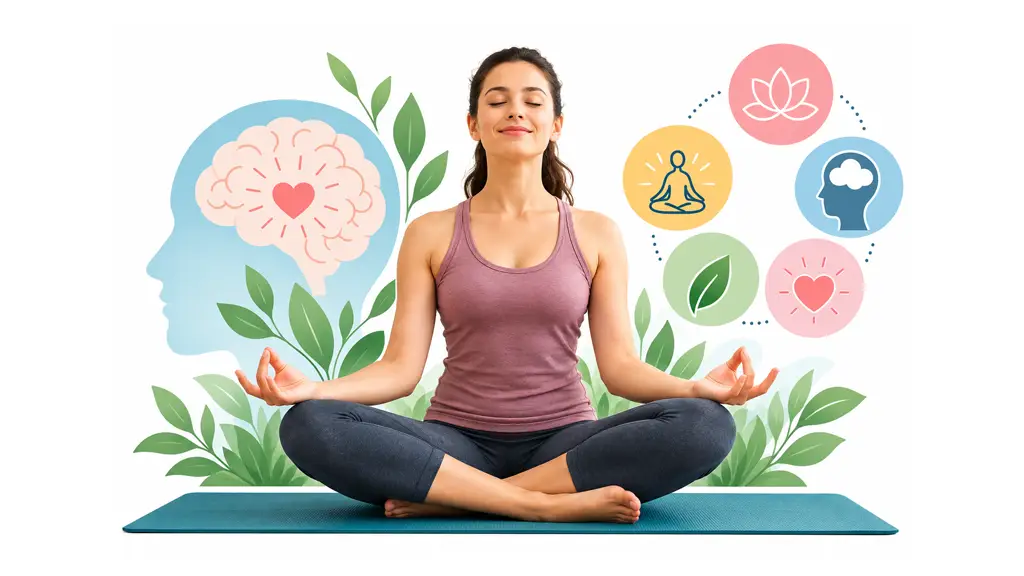


Strong evidence and research highlight the real benefits of yoga for mental health. Yoga creates new brain connections and improves cognitive skills. It is even considered more effective in anxiety regulation than stress management and education.
Studies and Research
- Kundalini yoga can reduce the effects of generalized anxiety disorder, though be careful to note that cognitive behavioral treatment remains the priority for primary treatment.
- A systematic review by Harvard Medical School highlighted the benefits of yoga for mental health. Regular yoga can reduce state anxiety and trait anxiety.
- Boston University’s School of Medicine has highlighted that yoga is known to increase levels of gamma-aminobutyric acid (GABA), which calms the nervous system. Low levels of this neurotransmitter have been linked to depression and anxiety disorders in the past.
Let’s understand these benefits of yoga for mental health from the biological and neurological perspective:
- Regular yoga reduces cortisol, a stress hormone linked to anxiety. Anxiety stimulates the hypothalamic-pituitary-adrenal axis, filling the body with stress hormones like adrenaline.
- Pranayama lowers heart rate, reduces blood pressure, and relaxes the body. This is because it triggers the vagus nerve, which activates the parasympathetic nervous system.
- One of the benefits of yoga for mental health is that it increases gray matter in the brain’s prefrontal cortex and hippocampus, which helps with emotional regulation and reduces anxiety.
Some Yoga Styles for You
- Restorative & Yin Yoga is best for stress, panic symptoms, and burnout. In this yoga, slow poses that are supported by props trigger parasympathetic activation.
- Hatha & Kundalini work well for mild to moderate anxiety disorder (GAD). In Hatha & Kundalini, gentle movement is paired with breathwork.
- Avoid severe acute anxiety, in which high‑intensity practices such as Vinyasa or hot/bikram yoga can sometimes mimic panic attack symptoms. These symptoms include a rapid heart rate or heavy sweating, especially for highly sensitive individuals.
Benefits of Yoga for Mental Health
Yoga improves focus, sleep quality, and memory by activating the nervous system and building mindful awareness. Multiple benefits of yoga for mental health are listed below:
- Regulates emotions and triggers
When doing yoga, we are highly aware of ourselves, which brings higher emotional intelligence. This high awareness connects us to our own feelings and helps us recognize others’ emotions as well—this process builds and develops emotional intelligence. Emotional intelligence is not just a mental skill—it can also be linked to physical relaxation.
These benefits of Yoga for mental health go far beyond positive thinking; it resets your biological state with the right posture, grounding, and breathing exercises. It lowers cortisol, reduces the fight-or-flight response, and increases heart rate variability. Yoga calms the amygdala, making the brain’s danger and threat center less alarmed and hyperactive.
- Calms the nervous system
Yoga helps health by moving your autonomic nervous system from high-alert survival mode called fight-or-flight into the parasympathetic rest-and-digest state.
This biological change, which facilitates the benefits of yoga for mental health, takes place in three ways:
- Vagus Nerve Activation
Slow, controlled yogic breathing, known as Pranayama, especially when you extend your exhales, directly stimulates the vagus nerve, which is the main road of the parasympathetic system.
Vagal stimulation tells your brain that the body is safe, quickly lowering your heart rate, reducing blood pressure, and turning down stress hormones such as cortisol.
- Boosting Calming Brain Chemistry
Chronic stress reduces levels of GABA, or gamma-aminobutyric acid, which is the brain’s main inhibitor that helps calm overactive neural signals.
Research shows that the physical postures, called asanas, and focused breathwork in yoga greatly raise brain GABA levels. Higher GABA works like a brake on mental chatter, easing anxiety, panic, and constant worry.
- Down-Regulating the Amygdala
When the sympathetic system stays chronically active, the amygdala, which is the brain’s threat-detection center, becomes overly reactive.
By focusing your attention on sensations and breath in the present moment, yoga trains the prefrontal cortex, the executive reasoning center, to calm an overactive amygdala. This reduces emotional reactions and helps you respond to daily stressors with more calmness.
By combining movement, deep exhalation, and mindful presence, yoga works from the bottom up to change high-stress physical states into lasting mental calm.
3. Corrects overthinking
A lack of GABA and overactive cortisol cause overthinking. Yoga helps fight overthinking and anxiety by breaking the brain’s habit of stuck worry cycles and bringing your focus back to what your body’s feeling right now.
- Quiets the Default Mode Network (DMN)
Overthinking comes from a brain network called the Default Mode Network. This part of the brain loves to replay the past, worry about the future, and spiral in thoughts. Yoga interrupts this cycle. When you pay attention to your breath and how your body holds each pose, your brain shifts away from the DMN. This pause breaks the thought loop.
- Increases Calming Neurochemicals
One of the benefits of yoga for mental health is that it combines movement with intentional breathing. This combination boosts GABA, a natural brain chemical that calms brain signals. GABA works like a brake on the mind. It slows down the rush of thoughts, reduces muscle tension, and helps your heart rate settle. Higher GABA levels make it easier to feel balanced when anxiety tries to take over.
- Down-Regulates the Stress Response
When you breathe deeply and slowly, especially when you extend the exhale, you activate the vagus nerve. It helps switch on the parasympathetic nervous system—the part that tells your body to relax. As a result, stress hormones drop. This breaks the chain of thinking at the physical level.
Instead of trying to push away anxious thoughts, yoga offers a different path. It uses the body as a place to land. By grounding yourself in breath and posture, you calm the brain from the outside in—starting with the body and moving up to the mind.
4. Releases physical tension
Anxiety shows up in the body: with stiff shoulders, a clenched jaw, and shallow breathing. That muscle tightness starts a loop: the brain reads the tension as a threat. Keeps stress high. Yoga stops this loop from the ground up.
By holding yoga poses, you stretch tissue and tighten muscles before you relax them, which lets the body release. Moving actively raises blood flow. Washes away stress hormones such as cortisol and adrenaline.
At the same time, slow, deep breaths tell the vagus nerve to switch on the rest system, which slows the heart and eases muscle tightness. When the body relaxes, the brain learns the surroundings are safe, so the physical feeling of anxiety eases.
5. Breath management
Simple breathing exercises can help a lot with anxiety and its symptoms. Slow breathing can remove negative thoughts. There is scientific evidence of the connection between breathing yoga and cognitive function. Yoga and breathing activate the body’s parasympathetic nervous system. This helps relax the body because it is the body’s rest-and-digest function, which can make it harder to relax when dysregulated. This relaxed state is essential to recover from an emotional episode and manage stress.
An activated sympathetic function and dysregulated parasympathetic function can drive the body into a hyper-alert state. Mindfulness breathing can bring your awareness into the present moment and activate the parasympathetic system.
6. Develops coping mechanisms
One of the benefits of yoga for mental health: Yoga is like a lab for building mental strength. On the mat, you put yourself in uncomfortable positions, such as holding a tough pose, and you learn to stay calm by breathing consciously instead of reacting fast.
This practice works the part of the brain that helps you control impulses and stay steady. Over time, you learn to watch body feelings and anxious thoughts without judging, and you do not run away or spiral. You create tools, like breathing out slowly and scanning your body, that you can use right away, outside the mat whenever anxiety comes on in everyday life. Instead of being carried by stress, you build a habit of pausing between a feeling and your reaction.
Yoga Poses to Help Anxiety
Let’s explore the benefits of yoga for Mental Health by studying yoga poses for anxiety.
- Upward-facing dog (Urdhva Mukha Svanasana)
The upward-facing dog is a heart-opening backbend that rectifies the slouched position that is linked to anxiety. It allows deeper breathing, which regulates emotional releases and a sense of calm.
- Lie flat on the mat.
- Place your palms beside your lower ribs.
- Press firmly into your hands and straighten your arms
- Lift your chest upwards and roll your shoulders back.
- Keep your thighs and knees lifted
- Look straight ahead or upward
- Hold for 15 to 20 seconds, then breathe slowly
2. Cat Pose (Marjariasana)
The cat pose involves rounding the spine to bring awareness into your mind, releasing anxiety and nervousness.
- Begin on hands and knees in a tabletop position
- Inhale, exhale, and bend your spine towards the ceiling
- Point your chin towards your chest
- Drop your head and look towards your navel
- Inhale as you release and return to a neutral flat tabletop pose
3. Cow pose (Bitilasana)
It relieves anxiety by synchronizing slow, deep breathing with gentle spine movement to calm your nervous system.
- Get on all fours in a tabletop position while keeping the shoulders directly above your wrists
- Bring your core up towards the spine
- Take a slow inhale as you let your stomach drop to the floor
- Bring your shoulder blades together and draw your arms through your heart.
- Bend your upper back instead of your lower back
- Look upwards without crunching your neck
- Exhale and do the cat pose.
4. Extended puppy pose (Uttana Shishosana)
The “extended puppy pose” combines aspects of Child’s Pose and downward dog to create a stretch through the spine and shoulders.
- Begin on your hands and knees.
- Walk your hands forward.
- Keep your hips stacked above your knees.
- Lower your chest toward the floor.
- Rest your forehead or chin on the mat.
- Breathe slowly and deeply.
5. Child’s pose (Balasana)
Child’s Pose is one of the restorative yoga poses and is commonly used during anxiety, stress, and emotional overwhelm.
- Kneel on the floor.
- Bring your toes together.
- Sit back on your heels.
- Extend your arms forward.
- Lower your forehead to the mat.
- Breathe deeply for one to five minutes.
6. Trikonasana (Triangle pose)
Triangle Pose is a posture that develops stability, balance, and mental focus.
- Stand with feet wide
- Turn one foot outward.
- Extend both arms sideways.
- Reach forward. Lower one hand toward your shin or ankle.
- Extend the arm toward the ceiling.
- Keep your chest open
7. Parsvottanasana (pyramid pose)
Parsvottanasana, or the intense side stretch, stretches your hamstrings and strengthens your quads, and also a whole lot more!
- Stand in Tadasana, or the mountain pose
- Step your right foot back in an extended gap
- Keep it flat and level; your right and left heels are in a line
- Reach your arms behind your back and bring your palms together
- If you feel flexible, move your wrists away from your back and stretch your arms, or even bring your palms in a prayer pose on your back
- In an inhale, bring your torso down and look at your big toe
- Release and lift through your belly
8. Mountain Pose (Tadasana)
Tadasana helps you ground into the present moment, lowers stress, controls breathing, and calms your nervous system. Although Mountain Pose looks simple, it teaches grounding, alignment, and stability, and those qualities can become very powerful when anxiety visits.
- Stand tall, placing your feet together or spaced about hip-width apart.
- Spread your weight evenly across both feet.
- Make your spine long and straight.
- Let your shoulders relax and drop down.
- Look ahead, keeping your gaze forward.
- Breathe slowly in a controlled way.
Yes. Yoga interrupts thoughts by shifting your focus to the breath, body movement, and awareness of the present moment. This helps reduce rumination and improves focus, making it easier to manage overthinking.
Yoga can be a complement to anxiety management, but yoga should not replace professional mental health treatment when it is needed. People with severe anxiety disorders should consult a qualified healthcare professional and use yoga together with evidence‑based therapies when it is appropriate.
Yoga and meditation both offer mental health benefits. Yoga mixes movement with mindfulness and breathwork, while meditation focuses mainly on mental awareness and concentration. Many people find that practicing both together gives relief from anxiety.
Some of the effective yoga poses for anxiety are Child’s Pose (Balasana), Extended Puppy Pose (Uttana Shishosana), Cat‑Cow Pose, Mountain Pose (Tadasana), Triangle Pose (Trikonasana), Legs‑Up‑the‑Wall Pose (Viparita Karani), and Corpse Pose (Savasana). These poses encourage relaxation, grounding, and mindful breathing.
Research suggests that yoga may increase matter in parts of the brain that handle emotional regulation, attention, and memory. Yoga also helps produce calming neurotransmitters such as GABA, which can reduce anxiety and improve mental well‑being.
Some people feel relaxation after just one session, but lasting benefits usually grow with steady practice over several weeks. Regular yoga trains the body and brain to respond calmly to stress over time.