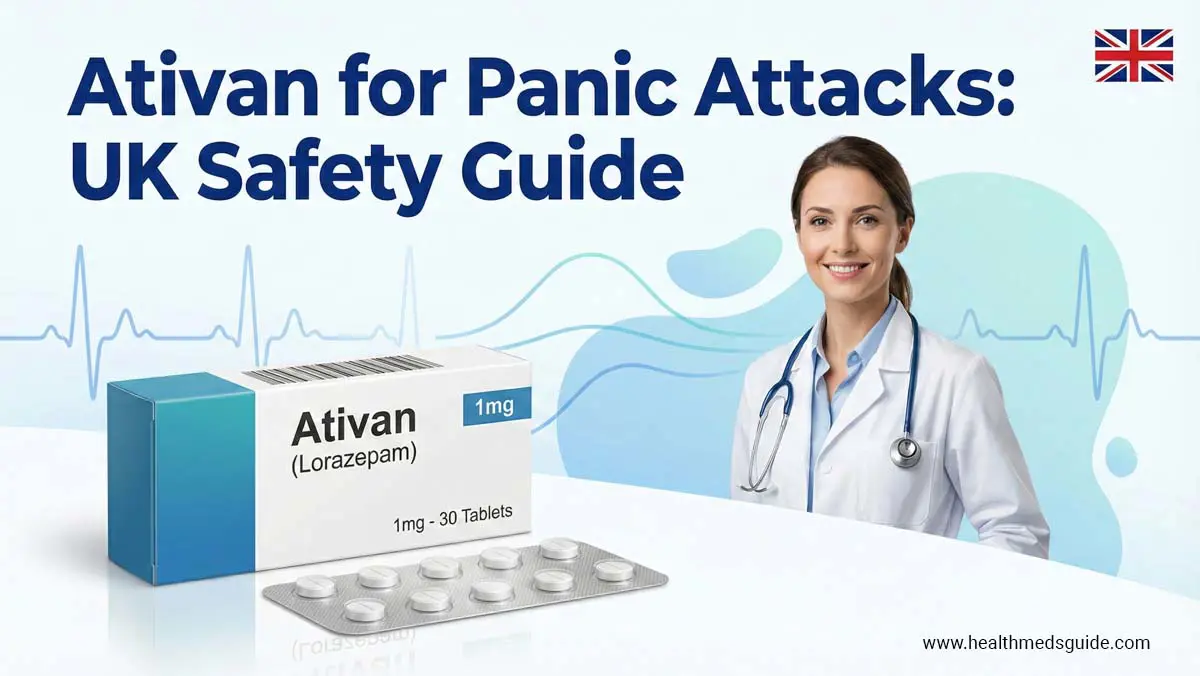
Ativan for Panic Attacks: UK Usage & Safety Guide
The symptoms of panic attacks are overwhelming, which means sudden surges of fear with physical symptoms such as chest pain, sweating, trembling, dizziness, and a racing heartbeat. While a range of treatments exists, one medication that is sometimes discussed is ativan, commonly known as lorazepam, a benzodiazepine. This guide covers how ativan is used within the UK, the ativan for panic attacks UK guide, the benefits and risks, and safer, longer-term management options.
What is Ativan (Lorazepam)?
Ativan (lorazepam) is a benzodiazepine, which is a class of medications that function by maximizing the calming effects of GABA, a neurotransmitter in the brain. It is indicated for the treatment of:
- Acute anxiety
- Severe panic attacks
- Insomnia (short-term)
- Alcohol withdrawal
Pre-procedure sedation
It is rapid-acting, sometimes within 20 to 30 minutes, which makes it effective in episodes of acute anxiety. Ativan is a common benzodiazepine used for pre-procedure sedation to reduce anxiety, provide a calming effect, and cause a decrease in the ability to recall events related to the procedure.
The Pre-procedure Sedation Key Effects
- Sedation induces sleepiness or drowsiness, but most patients can still respond to basic instructions.
- Anterograde Amnesia: Prevents the formation of new memories after the drug has been administered, which is often a desired effect for patients who want to forget the surgical events.
- Anxiolysis alleviates preoperative anxiety and stress.
Ativan for panic attacks UK guide
So, after knowing the fact that ativan is used for the treatment of panic disorder. But as this medicine can be addictive, its use is restricted and can be used only by patients who have been prescribed it by their doctors.
Let us know if Ativan is prescribed for panic attacks in the UK or not. So, yes, Lorazepam is prescribed in the UK for panic attacks, but only in quite specific short-term situations. The NICE guidelines recommend benzodiazepines only for very short-term crises, due to the risk of dependence and tolerance.
General Practitioners usually reserve lorazepam for:
- Severe panic attacks that are resistant to other forms of treatment.
- Short-term stabilization while awaiting therapy or other medications that may take longer to become effective.
- Hospital or emergency settings.
Ativan is typically not advised for panic disorder and should not be prescribed on a regular or long-term basis.
Let us acknowledge the key general Practitioners’ uses for Lorazepam
- Short-term anxiety relief: For managing severe anxiety symptoms or anxiety associated with depression that interferes with daily functioning and does not respond to nonpharmacological treatments.
- Pre-medication: Anxiety relief, sedation, or amnesia before a medical, dental, or surgical procedure.
- Acute situations: General practitioners can prescribe it for a short period of time to treat acute panic attacks or severe, transient situational stress.
- Anxiety-related insomnia: Used to treat anxiety-related sleep problems, usually as a single dose taken at bedtime.
How Ativan Works During a Panic Attack
During a panic attack, lorazepam amplifies the effects of the neurotransmitter GABA in the brain. This has a calming effect by slowing down the activity of the central nervous system (CNS). Let us learn about the Lorazepam mechanism of action:
- Absorption: Ativan is well absorbed after oral administration, which is the first stage of its action. Two hours after oral administration, peak concentrations are then reached. This medication has a bioavailability of about 90%. Lorazepam also passes through the blood-brain barrier passively.
- Distribution: This medication binds to about 90% of plasma proteins and has a volume of distribution of 1.3 L/kg. The medication utilizes passive diffusion to cross the blood-brain barrier.
- Metabolism: Ativan undergoes enterohepatic recirculation and conjugation in the liver. The metabolite lorazepam glucuronide is not active. Without first undergoing cytochrome P450 metabolism, the drug is directly glucuronidated. As a result, patients with hepatic dysfunction can safely take lorazepam with little effect on its pharmacokinetics.
- Excretion: Lorazepam has a clearance of 1.1±0.4 mL/min/kg and an elimination half-life of 14±5 hours. The urine is where the drug is mostly eliminated.
Due to its rapid onset, it is often more effective than many other medications at halting an escalating panic attack.
Ativan Dosage (Normal UK Guidelines)
Always follow your doctor’s specific prescription. For acute anxiety/panic, physicians may prescribe:
- Maximum daily doses vary according to the case.
- 0.5 mg to 2 mg, usually as a one-off dose or short course
| Condition | Usual Recommended Dose | Maximum Daily Dose |
| Anxiety | 1 mg to 4 mg in divided doses every day | 4 mg daily. |
| Pre-medication before procedures or surgeries | Two to three milligrams the previous evening, followed by two to four milligrams one to two hours before the procedure | Varies according to the process and administration method. |
| Sleep issues (insomnia brought on by stress or anxiety) | 1 mg to 2 mg once before bed | Every day, 2 mg |
Lorazepam is normally taken:
- As a tablet
- Occasionally, as a liquid or injection (hospital use)
IMPORTANT SAFETY INFORMATION
This class of drugs, benzodiazepines, has numerous risks associated with their use and must be prescribed cautiously.
- Dependence & Withdrawal
Lorazepam is addictive. Taking it every day for just a few weeks may lead to:
- Addictiveness
- Tolerance: higher doses needed
- Withdrawal symptoms
For this reason, most UK prescribers cap lorazepam at 2 to 4 weeks maximum, often far less.
- Side Effects
Common side effects include:
- Drowsiness or sedation
- Slowed reaction times
- Memory problems
- Dizziness
- Confusion, especially in older adults
Serious but rarer effects:
- Difficulty breathing
- An extremely severe allergic reaction
- Paradoxical agitation
- Smoothness of manner can be replaced by increased anxiety.
- Interaction:
Lorazepam should never be combined with the following:
- Alcohol
- Opioids such as codeine and tramadol
- Sleeping pills
- Other sedatives
- Driving & Legal Considerations (UK)
Lorazepam is a controlled drug. You must:
- Avoid driving if you feel drowsy or impaired
- Keep it in properly labelled packaging
- Carry proof of prescription while traveling.
- Impaired driving may lead to prosecutions.
Who Should Avoid Ativan?
Lorazepam is generally not used for:
- People with a history of substance misuse
- Pregnant or lactating persons
- Those with severe respiratory conditions
- Older adults, unless necessary
Alternatives for the Management of Panic Attacks (First-Line in UK)
Because benzodiazepines are not a long-term solution, doctors generally recommend:
- Cognitive Behavioural Therapy (CBT)
The NHS believes CBT is the most effective long-term therapy for panic disorder.
- Antidepressants
Such as:
- SSRIs (sertraline, escitalopram)
- SNRIs include venlafaxine.
These prevent panic attacks from happening but do not take effect immediately.
- Non-Pharmacological Interventions
- Slow breathing exercises
- Grounding techniques: 5-4-3-2-1 method
- Mindfulness and relaxation
- Exercise and lifestyle changes
When to Seek Immediate Help:
Seek immediate medical care if:
- Panic symptoms are accompanied by chest pain, fainting
- Difficulty in breathing.
- A panic attack typically lasts between 20 and 30 minutes.
- You feel unable to stop taking lorazepam.
- You have taken lorazepam with alcohol or opioids
Call 999 in an emergency or 111 for urgent advice about medical treatment.
Summary
Ativan, which is also known as lorazepam, can be an effective short-term, fast-acting medication for severe panic attacks in the UK. However, due to dependency risks and side effects, it is not a long-term treatment and is usually only prescribed during acute crises. Most people with recurrent panic attacks benefit more from antidepressants, CBT, and non-medication strategies that provide lasting relief.
Also Read